Writing / How I Cut Estimate Turnaround From Months to One Week
jul 2026 · 4 min
How I Cut Estimate Turnaround From Months to One Week
A specialist-agent pipeline handled 80% of the work, but line-item business judgment made the estimates usable.

By the time the site crew got back to the office, a base estimate was waiting. They had uploaded the site photos and notes through a mobile app, and an AI estimation system had started building the estimate before they returned.
A comparable job used to take 3 weeks to 2 months: a senior estimator reviewing details and going back and forth with teammates before a number went out. Every job depended on the same scarce person. What this run taught me: in expert workflows, clients don't buy intelligence. They buy their bottleneck disappearing.
My team of 3 built this system in 5 weeks for a construction exteriors company (anonymized here; the numbers are early internal results). The system supports roughly 20–22 users through a specialist-agent estimation pipeline, typically producing 25–30 estimates a week with peak capacity near 55–60.
The accurate total that still wasn't usable
The first build could get the total within its 5–10% target range, but it had "intelligence, not business understanding." The first version pushed the number out as if a close total completed the job, even when it wasn't a number the business would stand behind.
The company prices most regions from a baseline rate, but not every region has one. For a job in one of those regions, the company must decide which rate applies. A single-total output buries that choice.
We had to shape the output around the way this company actually operates. The useful turn came when the system presented the estimate as inspectable line items. Their estimators had always carried that line-level reasoning implicitly, folded into experience and assumptions. Making it visible changed the review: the estimator could inspect each line, see where a business choice entered (like that regional rate), and change only what needed changing.
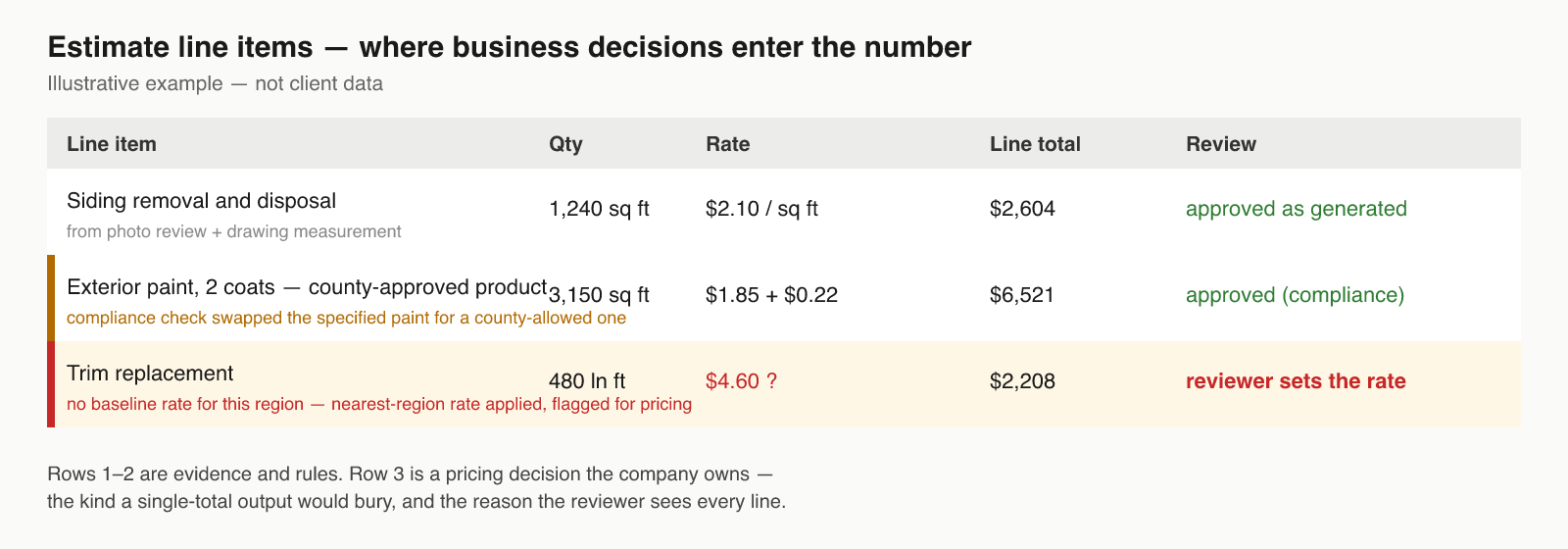 Illustrative example — not client data.
The estimate had to unfold in stages
Generating the entire estimate in one AI pass can produce a plausible result, which makes the shortcut tempting. But it loses the separate judgments production requires. Photo review, scope finding, clarification questions, estimate assembly, and document prep each add a different kind of judgment. Compressing all of that into one generation hides where the work actually happens.
We rejected both extremes: one-pass generation and a rigid, comprehensive sequence. We needed a broader pipeline with more specialized agents.
The design that held up was a set of agents with narrower jobs. One agent handles intake. A vision agent reviews the site material. Other agents cover the remaining stages. The coordinating agents handle the main estimate stages and can delegate narrower tasks, such as reviewing one document type or preparing one section of the final estimate.
A specific loss led to the compliance review. This client once accepted a job specifying a paint that county rules didn't allow, and they bore the cost. The county-paint loss became a review step in the pipeline.

Anthropic describes a similar orchestrator-worker pattern in its production research system: a lead agent divides work among specialized subagents. It also recommends a single agent when the work depends on one tightly shared body of information. Our tasks drew on different evidence: photo review and county compliance checks. Handling them separately let the estimator inspect each finding without forcing every job through the same sequence.
The expert checkpoint was part of the product
The system automates evidence gathering and estimate assembly, while a human approves pricing policy.
The system now does about 80% of the job. The senior estimator and the person who walked the site add a few hours of input per estimate instead of producing the whole estimate. Their scarcity no longer holds every job for weeks.
The remaining review covers margins and operating practices, which vary by company and by job. They are business decisions, and the line-item detail gives the reviewer a concrete place to approve or change them.
What the numbers say so far
I want to be precise about what we can claim, because the results are early.
The new estimate totals are generally within 10–20% of the company's historic estimate totals, and the client is running a side-by-side test now, roughly 30–35 estimates over the last month. Most remaining differences come from the pricing decisions described above.
Turnaround is the clearer win. Active expert work and elapsed time are different measures, and both moved:

The client keeps adding users.
The side-by-side test will tell us more as it accumulates estimates. What has already changed is where the senior estimator's time goes: not into assembling estimates, but into the pricing judgments only they can make.